- Contact the parish office
Contents
ToggleVision statement
The Altar Servers ministry is a unique one in the Catholic Church. Other than priests and deacons, no one else is allowed to so closely play a part in the preparation of the Eucharist. Participation as an Altar Server is special. When you serve the priests and deacons, you serve the people of God, and above all, you serve Christ.
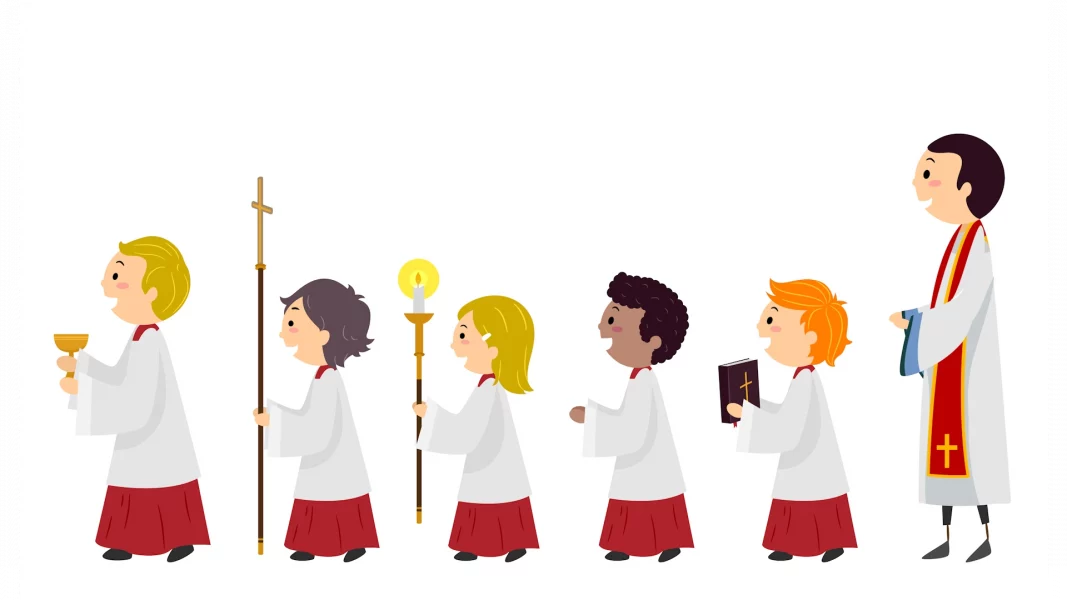
Altar Servers serve the worship of God and the people during liturgies by:
- leading the people in the responses and prayer
- preparing for the celebration of the liturgy (usually Mass)
- helping the other ministers during liturgies (usually Mass)
Who may be Altar Servers?
Altar Servers must:
- be in the Primary Six year or older
- be trained
- have the written support of parents or guardian
- always be in time, be neat, clean and tidy
Altar Servers serve until the end of Key Stage 3 i.e. fourteen years of age, and may continue to serve with the permission of the parish priest.
Code of conduct for Altar Servers
- Altar Servers should arrive in the church 15 minutes before the liturgy
- They should sign the Altar Servers’ book in the priests’ sacristy
- They should put on robes and prepare the sanctuary for the Mass or the Liturgy
- They should be prepared to join in the prayers before and after Mass
- The Senior or oldest server assigns the tasks
- After the liturgy or Mass the sanctuary and church should be left tidy
- Robes should be hung up in the Servers’ sacristy
- Servers should greet the priest before leaving the Church
- Bullying of children / young people by their peers will not be tolerated.
Code of conduct for leaders / those training Altar Servers
- Adults will treat children and young people with courtesy, respect and dignity.
- There will be an adequate ratio of leaders to children / young people at all times.
- Leaders should avoid being alone with children / young people. If this is not possible the leader should ensure that they can be seen by anyone passing i.e. the door of the room should be left open or the door into the room has a window.
- Physical contact between children / young people and leaders will be appropriate at all times. Leaders will not engage in rough play or undertake any task of a personal nature with / for children / young people except in cases of medical necessity when the welfare of the child / young person depends on it.
- Leaders will always engage with children / young people in an open manner and care will not be taken to show favouritism.
- The leader will bring concerns to the appropriate authorities: i.e. The Down and Connor designated Child Protection Officers, the PSNI, Social Services or the NSPCC.
Altar Servers prayers
Prayer before Mass
Loving Father,
Creator of the universe,
You call your people to worship,
To be with you and one another at Mass.
I thank you for having called me
To assist others in their prayer to you.
May I be worthy of the trust placed in me
And through my example and service
Bring others closer to you.
I ask this in the name of Jesus Christ,
Who is Lord forever and ever.
Amen.
Prayer after Mass
Lord Jesus,
Thank you for the opportunity
To serve you during the Holy Mass.
In Your Sacred Presence,
My heart is filled with joy and peace.
May Your Spirit always guide me
So that I may grow in your love
By the grace of the Heavenly Father.
Amen.
Glory be to the Father,
And to the Son,
And to the Holy Spirit,
As it was in the beginning,
Is now,
And ever shall be,
World without end.
Amen.