- Official website
- Safeguarding Privacy Notice
- Contact the parish office
Contents
ToggleParish Safeguarding Committee (PSC)
Membership
- Colm Crilly (Chair)
- Anthony King
- Kathleen Mc Grath
- Canon Denis Mc Kinlay
Function
The PSC has several functions, but these can be divided into two broad areas:
- raising awareness about safeguarding in the parish
- putting in place best safeguarding arrangements within the parish
Key roles
The PSC is required to:
- be aware of all parish activities (including the activities of external groups using parish premises) which need to comply with Safeguarding Policy and Procedures
- raise awareness of what safeguarding involves at parish level
- offer information and advice on safe practice to individuals, volunteers and group leaders involved with children / young people and adults in the parish
- make sure church activities are provided in a way that children / young people and adults are looked after safely and protected from abuse
- publicise contact details of the relevant statutory and Diocesan safeguarding personnel widely
- ensure that the parish complies with legislation regarding the processing of safeguarding information (record retention and disposal)
Procedures for recruitment and selection
The following steps are necessary to ensure good practice:
- Defining the Role – this involves thinking through exactly what you consider the role of a new volunteer to be, and what skills will be required for them to perform effectively.
- Application Form – this should be supplied together with appropriate information of what is expected of the volunteer i.e. clear job / role description and a Code of Conduct.
- References – two references should be obtained from people who are not family members or the parish priest. References must be taken up in writing and may be followed up orally if further clarification is necessary.
- Declaration – all volunteers will be asked to declare any past criminal convictions, and cases pending against them, or any investigation of a complaint that is unresolved. This information is held confidentially by the Diocesan Registered Person).
- Identification – the volunteer will complete the ‘Catholic Church Identity Verification Form’, providing the appropriate original identity documents as required for the AccessNI check.
- Vetting per AccessNI – the volunteer will complete the ‘AccessNI Form’ (online) to enable the Registered Person to obtain the background criminal record.
- Letter of Appointment – to be forwarded to the volunteer by the PSC or the parish priest upon the satisfactory completion of the process.
- Agreement – the volunteer should agree in writing to adhere to the Diocesan Child Protection Policy and Procedures and to attend an information session raising awareness of Child Protection issues. This will provide individuals with knowledge and skills and so increase their confidence to perform their role.
The Catholic Church is committed to best practice in child protection. An important aspect of ensuring children’s safety and well-being is the prevention of child abuse. The role of training and raising awareness of child protection issues, policies and procedures is fundamental to the development and maintenance of a safe environment.
Reporting a concern
Always pass on your concerns. Do not feel that you have to decide if it is abuse, or what type of abuse. Your role is clear pass it on. It is essential that information is shared as this allows those with responsibility for child protection to take action. Let the appropriate statutory agencies decide what should happen next.
The following chart details what you should do.
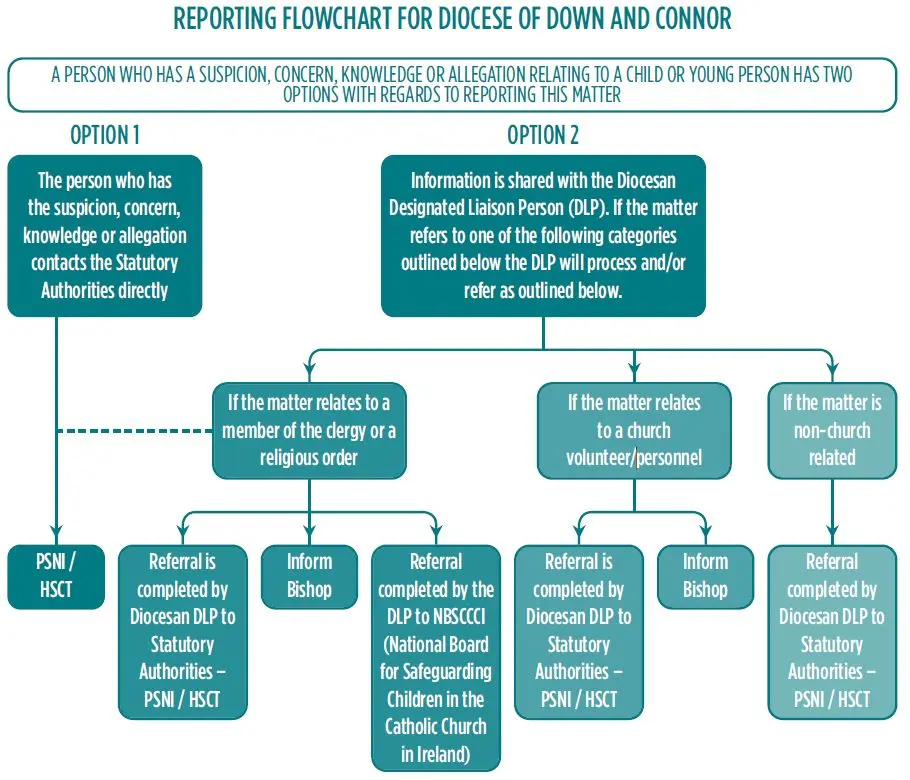
Sometimes it is difficult to decide what to do when something is bothering you about a child or about the conduct of an adult towards a child. Perhaps all you want to do is to talk to someone about it. In all cases, contact the Designated Liaison Person (Philip O Hara 07534992124) and they will provide advice and guidance.
You also always have the right to contact the statutory authorities directly if you prefer.
The key message to everyone is:
PASS IT ON
Complaints procedure for safeguarding concerns that are not allegations of abuse
Any member of the parish has a concern or complaint about some aspect of parish activities they should be able to voice this concern and have it resolved.
A complaint is defined as a grievance and/or the raising of a concern about breaches of codes of behaviour. Allegations or suspicions of child abuse do not fall into this category of general complaints, and should always be dealt with in accordance with relevant guidance. This complaints procedure is not for use by Church personnel who would use the whistle-blowing procedure to raise their complaint.
All complaints will be taken seriously and dealt with fairly and confidentially. Efforts will be made to quickly and informally resolve complaints through discussion with the parents/guardians, children/young people, volunteers/members of staff and clergy, as appropriate.
Parents/guardians, young people/children, volunteers, members of staff and clergy will be made aware that there is a complaints procedure. A copy of the complaints form is available in the parish office, website or from group leaders.
If a parent/guardian, young person or child is not satisfied with any aspect of the running of a particular activity, or the behaviour of any individual involved in that activity, the following steps should be taken:
First step
All complaints of this nature should be resolved using an open dialogue with the Church personnel involved e.g. Group leader. If resolution is not possible, the following step should be taken.
Second step
- The Church authority should be contacted by completing a complaints form. The Church authority has eight weeks to consider the complaint.
- A letter acknowledging receipt of the complaint should be sent within seven calendar days, enclosing a copy of the complaints procedure.
- All complaints must be thoroughly investigated.
- The Church authority may organise a meeting to discuss and hopefully resolve the complaint. This communication may also take place by telephone if a meeting is not possible. They will do this within fourteen calendar days of sending the acknowledgement letter to the complainant.
- Within seven days of the meeting or discussion, the Church authority will write to the complainant to confirm what took place and to set out any solutions that were agreed upon.
- If a meeting is not agreeable or possible, the Church authority will issue a detailed written reply to the complainant, setting out their suggestions for resolving the matter within twenty- one calendar days of sending the acknowledgement letter to them.
- If the complainant is still not satisfied at this point, they should contact the Church authority again.
At the conclusion of this step, the Church authority may decide to take further action on the complaint. If, however, the Church authority decides not to take further action, the process is completed.
Useful contacts
Towards Peace
Towards Healing
Children’s social services gateway team
- During normal working hours (Monday – Friday: 09:00 – 17:00)
- Belfast HSC Trust 028 9050 7000
- South Eastern HSC Trust 0300 1000 300
- Northern HSC Trust 0300 1234 333
- Southern HSC Trust 0800 7837 745, 028 3756 7100
- Outside normal working hours (Friday 17:00 – Monday 09:00, including public holidays)
- Regional Emergency Social Work Service 0800 1979995, resws1@belfasttrust.hscni.net
Adult social services gateway team
- During normal working hours (Monday – Friday: 09:00 – 17:00)
- Belfast HSC Trust 028 9504 1744
- South Eastern HSC Trust 028 9250 1227
- Northern HSC Trust 028 9441 3659
- Southern HSC Trust 028 3756 4423
- Outside normal working hours (Friday 17:00 – Monday 09:00, including public holidays)
- Regional Emergency Social Work Service 0800 1979995, resws1@belfasttrust.hscni.net